
A Review of Gubarev’s book on the Donbass Revolution and Orthodox-Communist Syncretism
 By: Jacek C. Kaminski – translated by Jafe Arnold
Jacek C. Kaminski is a Polish journalist and leftist activist. He is an editor of “Socjalizm Teraz” (Socialism Now), the co-founder of the Movement for Social Justice, and the Polish representative of the International Human Rights Movement “World without Nazism.”

 avel Gubarev’s book The Torch of Novorossiya is an extremely important source for understanding the essence of the dramatic political and military struggles now taking place in Ukraine. We are dealing not only with the testimony of an important participant in the events, but also the bold forecasts of a political visionary which have a fair chance of being realized.
In Poland, the 32-year old figure of Pavel Gubarev might be forgotten, but in Ukraine, and especially in Donetsk, he still has a considerable number of followers. We recall that the author was one of the initiators of the uprising in Donbass which led to the proclamation of the Donetsk People’s Republic and the civil war in Ukraine. After the victory of the Euromaidan in Kiev, he initiated the creation of the People’s Militia of Donbass which became the core of the DPR army. On March 1, 2014, Gubarev became the People’s Governor of the Donetsk region, a development which gave the signal for an uprising against the Euromaidan putschists of Kiev.
After being detained by the Security Service of Ukraine (SBU) within a week, he was released months following his arrest in the course of war prisoner exchanges thanks to the efforts of the rebel garrison in Slavyansk and the legendary Colonel Igor Strelkov. During the war, Gubarev organized logistics and supplies for Slavyansk after being stormed by soldiers of the Kiev junta and he stood at the head of the “Novorossiya” political movement. He now holds some criticisms of the current authorities of the people’s republics of Donbass, but he nevertheless believes in the realization of his idea of a Great Novorossiya. His proposed vision makes up one of the parts of the publication.
 By: Jafe Arnold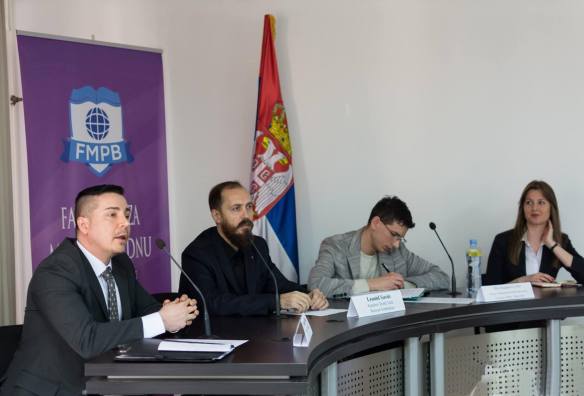
 n Wednesday morning, March 24th in Belgrade, Serbia, several dozen students, scholars, analysts, and distinguished guests including diplomatic representatives from Tunisia, Libya, Iran, Syria, Iraq, and Republika Srpska gathered at the University of Belgrade’s Faculty of International Politics and Security for the conference “The Balkans and the Middle East: Interconnections and Intersections.” Organized by the faculty in cooperation with
  By: Gustavo Aguiar – t
 n the 1960’s, at the height of the hippie movement and amidst protests against the Vietnam War, a new type of man emerged: the pacifist man whose anti-militant, progressive and social democratic spirit (with crisp Trotskyist tears) served as the cement for consolidating a redefinition of the revolutionary status established by the old proletarian left of the 19th century. Far from intending to justify the war crimes perpetrated by Yankee detachments in North Vietnamese villages and towns, or the negligible goals that led Lyndon Johnson and Richard Nixon to deploy tanks and helicopters on the plains of Indo-China, this paper aims to show the way in which the mentality of the New Left eventually engenders thought that is diametrically opposite to the slogans that adorn the signs in the subversive scenario of protests. Today, the same slogans are used as instruments of destabilization around the globe in service of the neocolonialist hyper-powers.
 n the
n the 

 hroughout the 19th century world affairs were dominated by Europe’s great colonial and imperial powers: Britain, France, Austria-Hungary, Germany, Russia, and the Ottomans on the south-eastern fringes of the continent. Rivalry and competition for the world’s resources between the European ‘great powers’ and colonial metropolises reached a peak at the end of the century. And this was the background setting that brought Europe to war and catastrophe during 1914-18. It was the first act in the dramatic demise of Europe’s world hegemony. The second and final act of the fall of Europe as the axis of global power took place during the 1939-45 war, which again had the continent as its main theatre of operations. World War Two caused unprecedented material destruction, and it took an appalling toll in human life. It also led to the first nuclear holocaust, triggered by the arbitrary decision of the government of the United States to test-drop recently built atomic bombs on the cities of Hiroshima and Nagasaki in August 1945
  syncreticstudies.com