Analysis of US and Israel Foreign Policy in IR Theory Perspective

Small Logo By: Joaquin Flores

Analysis of US and Israel Foreign Policy in IR Theory Perspective

The ”Yinon” Plan for Greater Israel

old-english-calligraphy-alphabet-the general public is thought to be often exposed to various printed opinion pieces and editorials weighing the pros and cons of the present international system, and the role of the US within it.

Many editors and publishers believe that this general public needs to be exposed to the conclusions of either various experts or popular agitators and polemicists, but that the audience either would not understand or appreciate an article based in the fundamentals and the framework, on the theoretical or academic level, which frames these debates.

A different view, the one taken by the author, is that the general public in fact does not read on this subject at all.  The core readership for writings on this subject are a different category of citizen-activists, whose interest goes beyond passing, and whose capacity to understand and appreciate the subject stands heads and shoulders above the general public.

The aim of this article is first to explain why the US’s Middle-east policy is a chauvinist/exceptionalist variation of irrational idealism in the language of International Relations, and how this policy can best be understood as originating from Israel, is it fits the needs of this state quite well and to the exclusion of others including the US itself..In order to explain to the readership why this is so, we will necessarily explain the relevance of IR theory to the subject at hand. Continue reading

Tragedy & Farce: Marxian Superstructural Analysis of Heterodox Social Movements

Small Logo By: Joaquin Flores

Tragedy & Farce: Reconsidering Marxian Superstructural Analysis of Heterodox Social Movements

  • Part I: Utopia vs. Myth,  the Poetry of the Past, and Social Revolution –  a general introduction to this series

Lar9_philippo_001z

Introduction

Old_English_Let us begin by resolving that there were three socio-political ideologies of modernity – liberalism, communism, and fascism; the 1st, 2nd, and 3rd political theories, respectively.  New developments in the global arrangement of socio-economic, ideological, and geopolitical forces in recent years force us to examine these with fresh eyes. On the one hand, we need to recognize the common philosophical heritage of all of these three ideologies in modernity, and thereby reveal the instances in which they consciously or unconsciously collude, while on the other hand delineating between their respective understandings of their roles as ideologies. In particular, the aim of this series is to reconcile the Marxian analytical framework with the base and super-structural features of new and syncretic socio-political movements, in their purely aesthetic form, as well as in their deeper ideological aspects.

Continue reading

A Brief History of Serbian Socialism, Part I

Small Logo  By: Stevo M. Lapchevich – translated from Serbian by Novak Drashkovic                                  & edited by Joaquin Flores

A Brief History of Serbian Socialism,
Part One

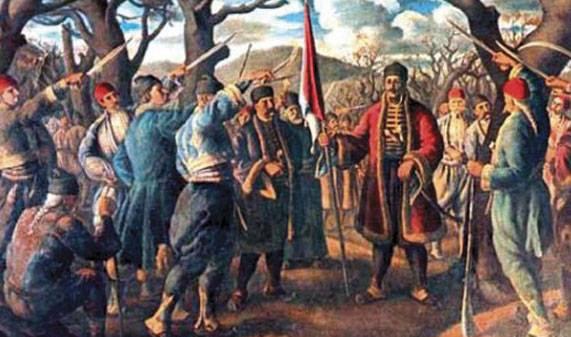
11823726_846881005407990_1286494311_n

The First Serbian Uprising inspired Serbian socialist thought and was connected to the early abolition of feudalism and landlordism

old-english-calligraphy-alphabet-the development of socialist ideas in the Balkans is closely tied to the political life of Serbia in the second half of the 19th century. Arising in a tributary country semi-independent from the occupying Ottoman Empire, in a land of lords and impoverished peasants living on the edge of survival, Serbia is a land of a people that was the first one in Europe to liberate itself from feudalism in the fourth decade of the 19th century.  We should recall here that Serbian prince Miloš Obrenović I issued a decree according to which arable land could only be owned by the people that are farming it, as opposed to the rising Serbian aristocracy.  Serbian socialist idea, unlike almost any other at that point in time, strived not only for the creation of a socially just, but also nationally independent and free state that would on the basis of self-government and self-determination unify the entire Serbian people.

Continue reading

“Responsibility to Protect” as Imperialism: The Libyan Case of 2011

Coat of Arms of the Libyan Republic - Art of heraldry - Peter Crawford By: Paul Alexander Haegeman, for the Center for Syncretic Studies –                                                                                                                   edited by Joaquin Flores

Humanitarian Intervention and The Responsibility to Protect (R2P) as an Instrument, Extension and Continuation of Neo-Colonialism and Post-Modern Imperialism:

The Libyan Case (2011). Considerations: The Kaleidoscope of International Legal Strategies and the Enabling of Wars of Aggression.


“Until the Day of Judgment, the Augustinian teaching on the two kingdoms will have to face the twofold open question: Quis judicabit? Quis interpretabitur? [‘Who will decide? Who will interpret?] Who answers in concreto, on behalf of the concrete, autonomously acting human being, the question of what is spiritual, what is worldly and what is the case with the res mixtae.”

    – Carl Schmitt, Political Theology II: The Myth of the Closure of Any Political Theology,     Michael Hoelzl and Graham Ward trans. (Cambridge: Polity Press, 2008) (first published 1970)

“Quod non fecerunt barbari, fecerunct barbarini”

(The peace of the police is not the calm of the temple but the silence of the tomb)

 9th July, 2014

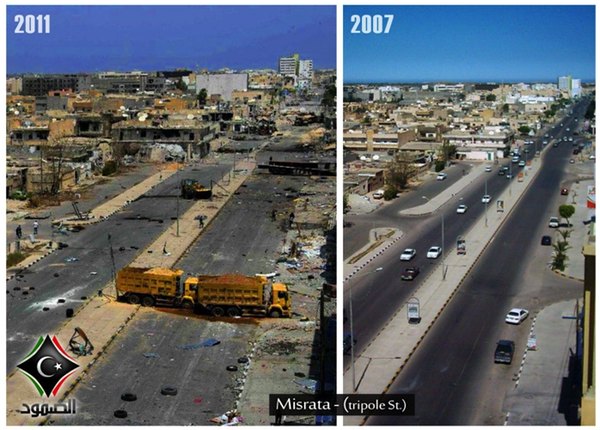
tumblr_m0wrr6qo1j1r1boeoo1_500 Libya-before-and-after

Continue reading

The Effectiveness of Soviet Interwar Foreign Policy

Small Logo By: Andrew Korybko

The Effectiveness of Soviet Interwar Foreign Policy

OLDENGLIoviet foreign policy before the Cold War has contradictorily been described as either being pragmatic and realistic or ineffective and idealistic. The true nature of interwar Soviet foreign policy lies somewhere in between both extreme designations. Although the Soviet Union did bungle some foreign policy priorities as a result of ideology, in others it was more pragmatic and realistic. As with any state’s foreign policy, it sought to advance national interests in a complex international environment. Given the preponderant influence of ideology in the Soviet Union at the time, as well as the unstable international environment in which policy was created, the case can be made that Soviet foreign policy was as successful as it could be within the limits placed upon it.  Continue reading