

 By: Padraig McGrath
Introduction: To understand why ‘scientism’, (the contemporary vulgarization of ‘the’ scientific method), exists in a perpetual state of cuspness – promoting the view that scientific inquiry is always seemingly ‘on the cusp’ of a final and absolute answer or truth – Gadamer’s ‘Horizon’ metaphor has yet another practical application. Gadamer put’s forward this metaphor in his development of Heidegger’s philosophical hermeneutics as articulated in the latter’s 1927 masterpiece ‘Being and Time.’ The utility of Gadamer’s metaphor goes beyond textual analysis and has application in multiple broad fields. Beyond a criticism of the possibility of applying the same vulgarized scientific method used in the physical sciences to the social sciences and humanities, these criticisms indeed may apply to the physical sciences themselves, which then asks us to make inquiries towards the viability of a revised epistemology. Marxist and later syncretic systems are also raised in relation to how the above is problematized. This allows us to see through a dialectical materialist lens how the ideological abuse of science in the contemporary Occident has not only an economic but also a geostrategic function – J. Flores
****************************************************************************
 n his 1960 magnum opus “Truth and Method” (“Wahrheit und Methode”), Hans-Georg Gadamer attempts to develop a theory of how we might be able to rescue overarching norms from the flux of history. To this end, Gadamer employs his famous “horizon”-metaphor. Gadamer’s idea is that one starts from a certain time and place inside history, and that as one learns and experiences more and more, the individual continuously approaches the horizon (the borders of ones worldview, the delimitations of ones culturally set-up version of reality, etc).
But as one continuously approaches the horizon, something strange becomes noticed – the horizon itself keeps moving farther away.
No matter how much one learns, history is never transcended. A terminus called “objectivity” is never reached. One remains forever embedded in “the history of effect” (“Wirkungsgeschichte”). Gadamer remains one of the twentieth century’s foremost exponents of German historicism.
Gadamer’s horizon-metaphor is applicable, not only to the discourse of history-culture-ethics-politics, but also to the natural sciences.


 n May 6
 By: Andrew Korybko
 he Center for Syncretic Studies is pleased to present another original academic piece, in full, from our Russian collaborator, Mr. Andrew Korybko. This analytic monograph was a previously in-house submission to the Moscow State Institute of International Relations.



 he rise of the protest movement in Donbass (and other regions of historical Novorossiya) which resulted in the proclamation of the People’s Republics, was a reaction to the coup d’etat in Kiev and aggressive Russophobic policies. It is no accident that the first legislative step of the new Ukrainian authorities was abolishing the language law, ratified in 2003 by the Verkhovna Rada in line with the European Charter for Regional or Minority Languages, which effectively pushed the Russian language out of the educational and cultural-information space of Ukraine. However, the popular movement in Donbass at the end of winter and spring 2014 also had deeper motives. The proclamation of the people’s republics of Donbass was a logical reaction to the dismantling of Ukrainian statehood as it had been formed in the framework of the Ukrainian Soviet Socialist Republic. The new Ukrainian authorities violated the tacit social contract of loyalty to the existing state in exchange for a guaranteed minimum of cultural-linguistic rights for the regions of the “South-East” (historical Novorossiya).
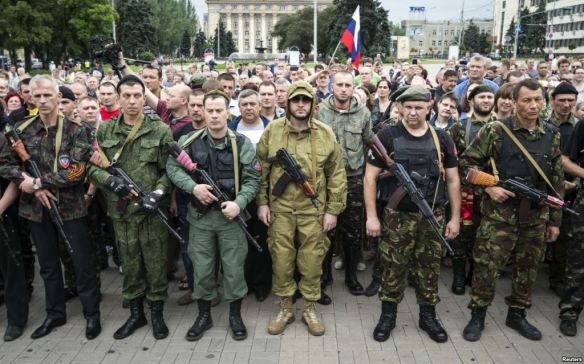
 y including the processes and event-related phenomenon “Russian Spring,” “war,” and “statecraft” in the title of this article, I am by no means implying any kind of intellectual provocation or attempting to realize a political order. On the contrary, the intended position here can be associated with the existence of millions of people who have in one way or another engaged (during wartime) in the creation of a completely distinct region, a will and fate of more than just one century tied to the fate of the Russian world.
  syncreticstudies.com