War and Statecraft in the Donetsk People’s Republic
 By: Dmitry Muza – translated by Jafe Arnold
Dmitry Evgenyevich Muza is a doctor of philosophical sciences, a correspondent-member of the Crimean Academy of Sciences, a professor at the Department of Sociology at Donetsk State University of Management, a professor at the Department of International Relations and Foreign Policy at Donetsk National University, and the co-chairman of the Izborsk Club of Novorossiya (Donetsk People’s Republic)
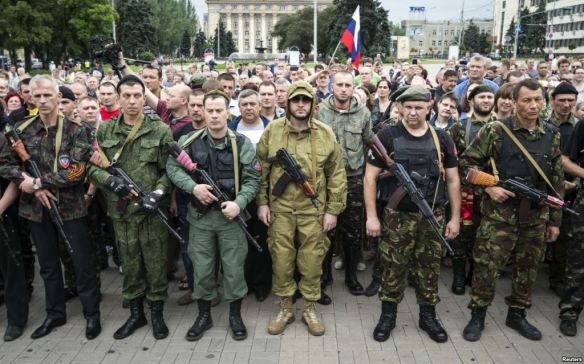
 y including the processes and event-related phenomenon “Russian Spring,” “war,” and “statecraft” in the title of this article, I am by no means implying any kind of intellectual provocation or attempting to realize a political order. On the contrary, the intended position here can be associated with the existence of millions of people who have in one way or another engaged (during wartime) in the creation of a completely distinct region, a will and fate of more than just one century tied to the fate of the Russian world.
Proposed below is a feasible analysis of three interrelated events: the “Russian Spring” in Donbass, the war [1], and attempts at state-building, each of which deserves separate reflection and evaluation from the position of both an “internal” and “external” observation.
All of these factors, I believe, are tied to an immanent logic which can be articulated as a centripetal process of reintegrating Donbass into the Russian civilizational, i.e., Russian-Eurasian, Orthodox space.[2]
In addition, a general exposition of what is happening in Donbass and with Donbass today requires some clarification of the region’s pre-crisis state. Such a clarification concerns both the recent and distant past directly associated with the region under consideration. By going through these layers of history, I intend to show the composition of Donbass in relation to the larger Russian civilizational space.
First of all, it is necessary to recall that the now forgotten regional referendum of March 27th, 1995 in the Donetsk and Lugansk regions was intended to restore socio-economic ties with the Russian Federation and enshrine the Russian language as a regional one in functional norms. Of no small importance is that this referendum was consistent with the Ukrainian law “On all-Ukrainian and local referendums,” but was still ignored by Ukrainian authorities. Secondly, it was Russian Donbass that accounted for the electoral base of Presidents Kuchma and Yanukovych who flirted with the ideas of closer integration with Russia and the Russian language (granting it a special status). Thirdly, there were considerable expectations surrounding the post-Maidan congress in Northern Donetsk in November of 2004 which expressed the region’s collective will on establishing genuine federalization, including economic autonomy for the Donetsk and Lugansk regions. Fourthly, it is important to emphasize that the significance of the recent “Euroregion Donbass” project which involved the Rostov, Belgorod, and Voronezh regions from Russia and the Donetsk and Lugansk provinces from Ukraine entailed tightening their cooperation, albeit with European investments and guidance. Continue reading →

 By: Jafe Arnold
 n May 6th, 2017 at la Terra dei Padri in Modena, Italy, Joaquin Flores gave a presentation on one of the most discussed – yet least understood – topics in contemporary politics, one that in so many reveals the importance of the nexus between the People and the geopolitical space in which the People dwells – Populism. The presentation focused on the differences between the varying types of populist ideologies and movements in East and West, grounding the discussion in a series of relevant examples of respective practical, contemporary manifestations.
  By: Andrew Korybko
 he Center for Syncretic Studies is pleased to present another original academic piece, in full, from our Russian collaborator, Mr. Andrew Korybko. This analytic monograph was a previously in-house submission to the Moscow State Institute of International Relations.


 he rise of the protest movement in Donbass (and other regions of historical Novorossiya) which resulted in the proclamation of the People’s Republics, was a reaction to the coup d’etat in Kiev and aggressive Russophobic policies. It is no accident that the first legislative step of the new Ukrainian authorities was abolishing the language law, ratified in 2003 by the Verkhovna Rada in line with the European Charter for Regional or Minority Languages, which effectively pushed the Russian language out of the educational and cultural-information space of Ukraine. However, the popular movement in Donbass at the end of winter and spring 2014 also had deeper motives. The proclamation of the people’s republics of Donbass was a logical reaction to the dismantling of Ukrainian statehood as it had been formed in the framework of the Ukrainian Soviet Socialist Republic. The new Ukrainian authorities violated the tacit social contract of loyalty to the existing state in exchange for a guaranteed minimum of cultural-linguistic rights for the regions of the “South-East” (historical Novorossiya).
 By: Alexander Gegalchiy – translated by Jafe Arnold
 n the below, second installment in CSS’ new series exploring syncretic-oriented themes among the “new-old” left, particularly in the Czech Republic, we are joined by Alexander Gegalchiy, who in July 2016 posed a series of hot topics to Czech communist ideologist Dr. Josef Skala to provide his original commentary. The resultant monologue contains a number of pertinent undertones, including a critique of the modern “left”, an approach to a socialist agenda from both a “pan-European” and “sovereigntist” perspective, a recognition of the changing superstructural manifestation of proletarian issues to involve formerly “reactionary” formations of the “right,” as well as a hint that so-called progressive notions as free migration and multiculturalism in fact have quite different origins and consequences for anti-capitalist and anti-imperialist motives.
  syncreticstudies.com