
CSS research fellow Jafe Arnold speaks at Amsterdam religious studies conference
 By: Jafe Arnold

 n January 23rd, 2018 CSS research fellow Jafe Arnold delivered a presentation entitled “The Eternal Return: Mircea Eliade’s Homo Religiosus and the Cognitive Science of Religion” at the “Religionism and Historicism” mini-conference in Amsterdam, The Netherlands. Organized by the University of Amsterdam’s Religious Studies and Western Esotericism Masters programs, in which Arnold is a student, the conference sought to address the theoretical and practical problems peculiar to the “religionist” and “historicist” approaches to the academic study of religious and esoteric currents.
Arnold’s talk focused on two case studies in this context that are relevant to the research of the Center for Syncretic Studies – the theories of the 20th century Romanian scholar of religion, Mircea Eliade, and the relatively new, interdisciplinary field of the Cognitive Science of Religion (CSR).
One of the Center for Syncretic Studies’ chief spheres of research is the relationship between different paradigms of understanding human religiosity, their reflections in intellectual discourse, and the possibilities of – as our mission statement says – “promoting an interdisciplinary approach which seeks to develop theory from unique combinations of ideas while also preserving space for and appreciating the utility of established orthodoxies.” As our Center’s name suggests, we are interested in syncretic perspectives on different schools of thought otherwise separated by time and ideological paradigms, especially in relation to the global “de-secularization” process which we believe is a pivotal, defining experience of the present era with profound implications for everything from scholarship to socio-political movements and geopolitics. The reconsideration of Eliade and the rise of CSR can be distinguished within this context of de-secularization. Continue reading


 n August 2016, the Center for Syncretic


 he rise of the protest movement in Donbass (and other regions of historical Novorossiya) which resulted in the proclamation of the People’s Republics, was a reaction to the coup d’etat in Kiev and aggressive Russophobic policies. It is no accident that the first legislative step of the new Ukrainian authorities was abolishing the language law, ratified in 2003 by the Verkhovna Rada in line with the European Charter for Regional or Minority Languages, which effectively pushed the Russian language out of the educational and cultural-information space of Ukraine. However, the popular movement in Donbass at the end of winter and spring 2014 also had deeper motives. The proclamation of the people’s republics of Donbass was a logical reaction to the dismantling of Ukrainian statehood as it had been formed in the framework of the Ukrainian Soviet Socialist Republic. The new Ukrainian authorities violated the tacit social contract of loyalty to the existing state in exchange for a guaranteed minimum of cultural-linguistic rights for the regions of the “South-East” (historical Novorossiya).
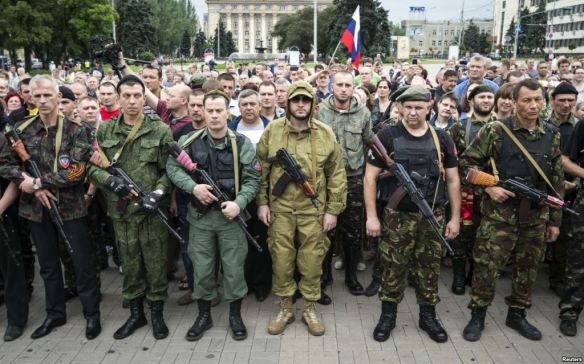
 y including the processes and event-related phenomenon “Russian Spring,” “war,” and “statecraft” in the title of this article, I am by no means implying any kind of intellectual provocation or attempting to realize a political order. On the contrary, the intended position here can be associated with the existence of millions of people who have in one way or another engaged (during wartime) in the creation of a completely distinct region, a will and fate of more than just one century tied to the fate of the Russian world.
  By: Alexander Gegalchiy – translated by Jafe Arnold
 n the below, second installment in CSS’ new series exploring syncretic-oriented themes among the “new-old” left, particularly in the Czech Republic, we are joined by Alexander Gegalchiy, who in July 2016 posed a series of hot topics to Czech communist ideologist Dr. Josef Skala to provide his original commentary. The resultant monologue contains a number of pertinent undertones, including a critique of the modern “left”, an approach to a socialist agenda from both a “pan-European” and “sovereigntist” perspective, a recognition of the changing superstructural manifestation of proletarian issues to involve formerly “reactionary” formations of the “right,” as well as a hint that so-called progressive notions as free migration and multiculturalism in fact have quite different origins and consequences for anti-capitalist and anti-imperialist motives.
  syncreticstudies.com