
 By: Padraig McGrath
The Synthetic Public Ideology of Putin’s Russia
The reconstruction of the Cathedral of Saint Alexander Nevsky is a microcosm of a broad social reality

 ituated adjacent to the Crimean Parliament building in Simferopol, the newly rebuilt Cathedral of Saint Alexander Nevsky is a magnificent structure. Gilded onion-domes, Greco-Roman columns and pediments – it looks every bit as classy as a well financed Orthodox cathedral should be. On entering, a question occurs to me, however – why are the icons not completely flat? The depictions of the various saints seem almost crypto-Catholic, more three-dimensional than you’d expect, not like Byzantine iconography. Novgorod it ain’t.
My friend Nikita explains that the local bishop is a western Ukrainian, so this style of iconography just seems more natural to him. Locals refer to it as “Disney-style.” I smile at this answer – is there a residual attempt toward “Ukrainianization” at work? Nikita doesn’t think so – any Orthodox bishop in present-day Crimea pushing an agenda of “Ukrainianization” on any level whatsoever would very quickly find himself without an office – sometimes a cigar is just a cigar.
 By: Alexander Gegalchiy – translated by Jafe Arnold
 n the below, second installment in CSS’ new series exploring syncretic-oriented themes among the “new-old” left, particularly in the Czech Republic, we are joined by Alexander Gegalchiy, who in July 2016 posed a series of hot topics to Czech communist ideologist Dr. Josef Skala to provide his original commentary. The resultant monologue contains a number of pertinent undertones, including a critique of the modern “left”, an approach to a socialist agenda from both a “pan-European” and “sovereigntist” perspective, a recognition of the changing superstructural manifestation of proletarian issues to involve formerly “reactionary” formations of the “right,” as well as a hint that so-called progressive notions as free migration and multiculturalism in fact have quite different origins and consequences for anti-capitalist and anti-imperialist motives.
  By: Dr. Eduard Popov – translated by Jafe Arnold
 he Center for Syncretic Studies finds great satisfaction in providing the following eye-opening interview, conducted by our esteemed colleague, Dr. Popov of the Russian Federation, who asked a number of pertinent questions to Dr. Josef Skala, a prominent communist leader in the Czech Republic. What the CSS has noted in a number of articles on related subjects is that there has been a steady return to the fundamental principles of worker socialism, while at the same time developing a syncretism with other socio-political phenomenon which previous generations would have, perhaps then correctly, identified as alien-class forces. Nevertheless, the further development of capitalism in the late 20th century and early 21st century has increasingly proletarianized social strata that previously were excluded from the valorization process. But today, these social strata are proletarianized, a process that has advanced in direct proportion to the total subsumption of other facets of society by capital, which may also be described as the commodification of all spheres of life.
 By: Jacek C. Kaminski – translated by Jafe Arnold

 By: Jafe Arnold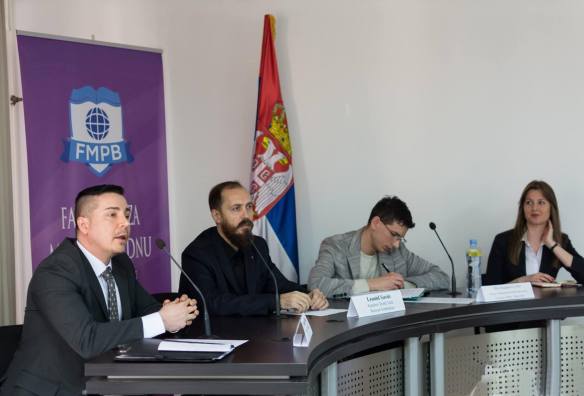
 n Wednesday morning, March 24th in Belgrade, Serbia, several dozen students, scholars, analysts, and distinguished guests including diplomatic representatives from Tunisia, Libya, Iran, Syria, Iraq, and Republika Srpska gathered at the University of Belgrade’s Faculty of International Politics and Security for the conference “The Balkans and the Middle East: Interconnections and Intersections.” Organized by the faculty in cooperation with
  syncreticstudies.com